Frequently Sick
Blog post description.
PRACTICAL EMBODIMENT
10/29/20253 min read
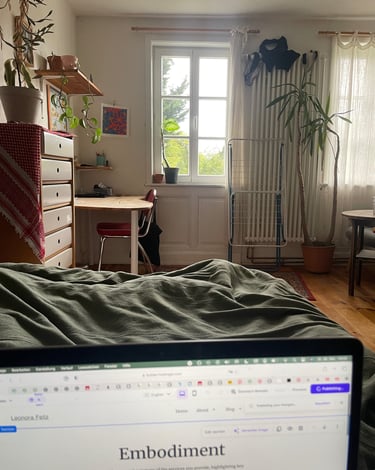
As I write this, I’m lying in bed on painkillers because of back pain.
I just got off a call where I expressed my frustration about being sick.
There’s an emotion I struggle to admit and give space to—jealousy.
As hard as it is to acknowledge, I feel a bit jealous of those around me who are rarely sick. Even though I know comparison doesn’t help anyone, I can’t stop the tears from running down my face as I think about how much I’d love to be like them.
Like those who seem to have a never-ending capacity, who don’t have to constantly check their “spoons” to see if they can manage the day or if two tasks might already be too much. Those who don’t have to cancel trips last minute because they got sick again—even after planning for months and looking forward to it so much. Not having to feel guilty for canceling plans with friends, knowing they now have to rearrange their own. Wondering what’s worse—being sick while visiting them, or staying home sick, regretting that maybe I could have dared to go.
And I’m not even someone who considers myself chronically ill, because I can still do a lot compared to others. Still, when I compare myself to people who complain about being sick for more than five days, there’s a heavy feeling in my stomach. Those who say they only get sick once a year—it hits hard. I’m sick so frequently that whenever it happens, I already plan for being down for two to three weeks. I’m glad when it turns out differently, but I’ve learned to keep my expectations low, to plan less so I don’t have to cancel too much later. People always come with a thousand recommendations, and even though they mean well, it hurts. It hurts that we so often blame the individual, that with every new illness I end up wondering what I did wrong this time.
What has changed over the years? I think I’ve become more humble about making plans, more aware that something might come up and I’ll need to adjust anyway. When I get sick, I’ve gotten used to working from bed, even when I’m only functioning at 20% or less. It’s like doing the opposite of Pomodoro—working in the breaks and spending the “work” periods listening to audiobooks or watching something. I’ve learned to accept that plans will change, that I won’t always follow through. I’ve always felt like the one with less energy than others, needing much more time alone than my peers. That used to frustrate me, but looking back, I see that I’ve learned to listen to my body quite well. Whenever I push past my limits, I feel the effects almost immediately.
From a somatic lens, my body is very present in my daily life. Many people move through life barely noticing their bodies, overworking and throwing themselves into everything. I would love to have more capacity, but the hardest part is comparing myself to expectations. It’s not just that my body’s needs are louder and more tangible—it’s that I feel alone in this. We live in a capitalistic society that puts so much pressure on productivity, even though productivity can mean different things for everyone. And for me, it often feels like my capacity is the one thing I constantly have to measure my worth against.
That I would stop forcing my body to live up to capitalistic expectations and take the time that im sick as moments to be more inwards with understanding that there will be other times ahead.
© 2025. All rights reserved.